Assembling a Team for a Sports Facility
Sports & Leisure · Riyadh, Saudi Arabia
The opportunity
A national sports authority in Saudi Arabia issued a request for proposals for the design of a 70,000 sq m specialist sports facility on the outskirts of Riyadh. The programme was substantial: dedicated animal husbandry buildings, quarantine facilities, indoor and outdoor competition arenas, a veterinary clinic with doping control laboratories, an administrative headquarters, staff accommodation and full site infrastructure including landscaping and dedicated logistics routes.
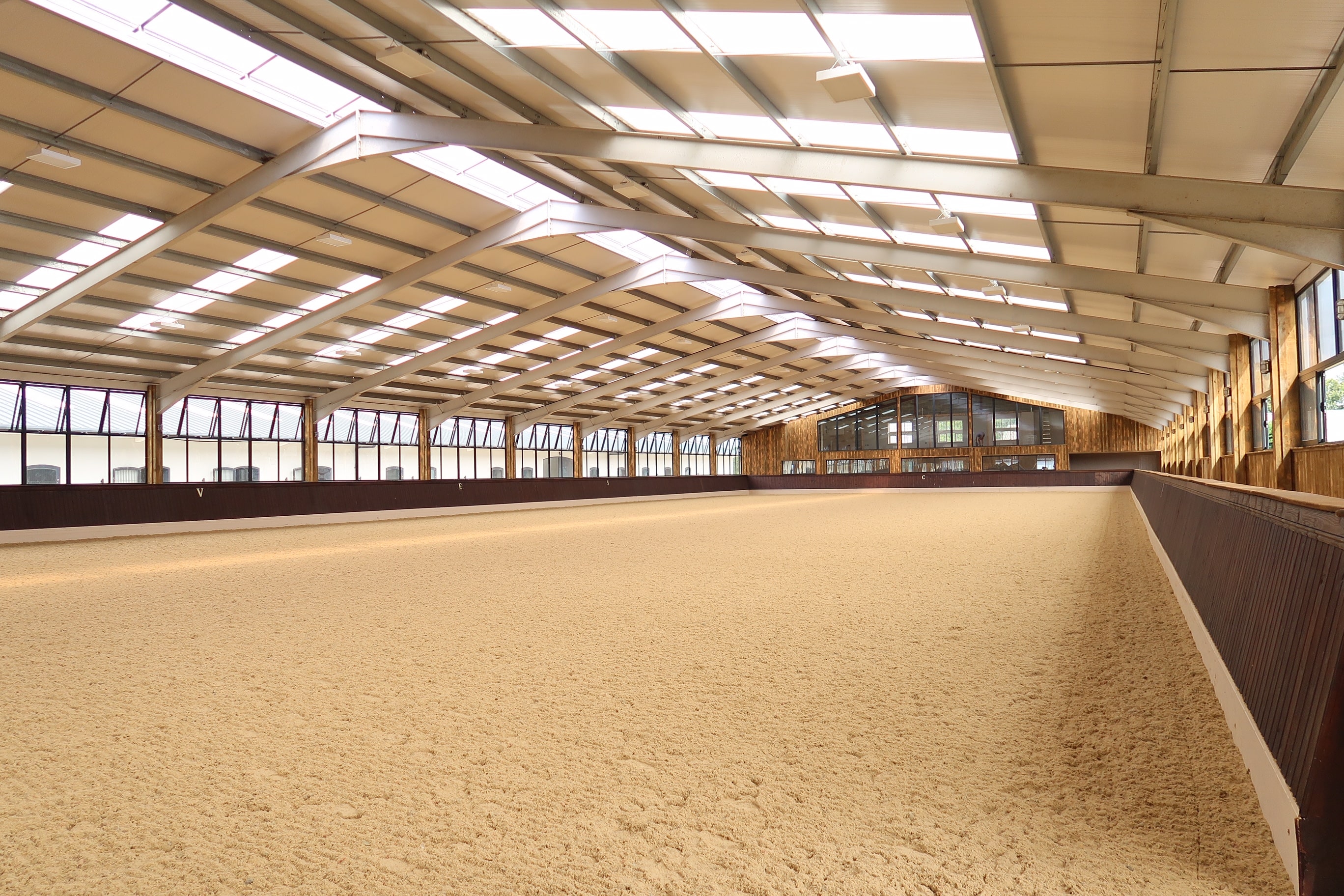
The brief specified compliance with international federation standards. The indoor arena alone required a competition surface of 40 by 80 metres with grandstands, VIP facilities and a two-level judging platform. Two outdoor arenas of 100 by 60 metres, training arenas, warm-up areas and a medical examination track completed the sporting programme. Beyond the competition facilities, the project encompassed restaurants, retail units, prayer areas, a media centre and a 50-room residential building for operational staff.
The design scope ran across five phases — from preliminary studies and soil tests through to final tender documents and statutory permits — demanding a team that could deliver architecture, engineering, interior design and specialist technical expertise under a single coordinated programme.
Our role
A Saudi engineering consultancy with a strong regional track record approached us to help assemble a competitive design team for the tender. The firm had the engineering capability — structural, mechanical, electrical and civil — but needed specialist architectural input that did not exist within its network.
We identified and introduced a European architecture practice with deep expertise in the relevant building typology, including competition-grade arenas and specialist support facilities built to international federation standards. To complement this capability, we brought in a second European practice — a generalist firm — to lead overall masterplanning, interior design and project integration.
We developed a detailed responsibility matrix defining the scope division across the three firms. The Saudi consultancy would lead on surveys, soil testing, infrastructure services, cost estimation and statutory permits. The generalist architect would lead masterplanning, architectural drawings, 3D perspectives, interior design and the presentation deliverables. The specialist practice would provide technical input on ventilation systems, arena specifications, quarantine protocols, monitoring infrastructure and compliance with international standards — while also carrying out peer review across later design phases.
This three-way structure gave the consortium the depth of a large multidisciplinary practice while allowing each firm to contribute precisely where its expertise was strongest.
The outcome
The consortium submitted a compliant proposal against the full five-phase scope. The team was subsequently invited to develop the design further as part of a paid competition — a restricted invitation extended only to shortlisted teams.
The engagement demonstrated how targeted team assembly and clear scope definition can transform a single firm’s capacity gap into a competitive multi-disciplinary consortium. By matching specialist European expertise with local engineering strength, the team presented a proposal that no single party could have delivered independently. The responsibility matrix — defining lead, support and peer review roles for every deliverable — gave the client confidence that the consortium would function as a coordinated unit rather than a loose grouping of subcontractors.